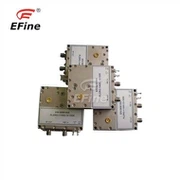
What is Voltage Controlled Oscillators?
Jul 10, 2023
Introduction:
Voltage Controlled Oscillators (VCOs) are fundamental components in various electronic systems and play a pivotal role in generating stable, controllable, and tunable frequency signals. They find extensive application in communication systems, signal processing, frequency synthesizers, phase-locked loops (PLLs), radars, and many other areas. This article provides an overview of the principles, design considerations, and applications of Voltage Controlled Oscillators.
1. Working Principles of Voltage Controlled Oscillators:
Voltage Controlled Oscillators generate periodic electrical signals with frequencies that can be tuned or controlled by a control voltage. The working principles of VCOs can be explained as follows:
1.1 Resonant Tank Circuit:
VCOs typically employ a resonant tank circuit consisting of an inductor (L) and a capacitor (C). The resonant frequency of the tank circuit determines the frequency of the output signal.
1.2 Active Device:
VCOs utilize active devices such as transistors or diodes to provide gain and compensate for energy losses in the resonant tank circuit. Common active devices used in VCOs include bipolar junction transistors (BJTs), field-effect transistors (FETs), and varactor diodes.
1.3 Control Voltage:
The control voltage applied to the VCO alters the effective capacitance in the resonant tank circuit, thereby changing the oscillation frequency. By varying the control voltage, the output frequency can be tuned over a certain range.
1.4 Feedback Mechanism:
VCOs employ a feedback mechanism to sustain oscillation. Positive feedback is achieved by feeding a portion of the output signal back to the input of the amplifier stage, reinforcing the oscillatory behavior.
2. Design Considerations for Voltage Controlled Oscillators:
Designing a Voltage Controlled Oscillator requires careful consideration of various factors to achieve desired performance characteristics. Key design considerations include:
2.1 Resonant Tank Selection:
The choice of inductor (L) and capacitor (C) values in the tank circuit determines the desired frequency range and stability of the VCO. The resonant tank circuit should be designed to achieve the target frequency with low phase noise and good frequency stability.
2.2 Control Voltage Range:
The control voltage range determines the tuning range of the VCO. Designers need to select appropriate biasing circuits and control voltage levels to ensure sufficient linearity and controllability over the desired range.
2.3 Linearity:
Maintaining linearity in the relationship between the control voltage and output frequency is essential for accurate frequency control. Nonlinearities can introduce unwanted frequency modulation or cause harmonics in the output signal.
2.4 Phase Noise:
Phase noise represents the random fluctuations of the output signal's phase, impacting the signal quality. Design techniques such as careful selection of active devices, noise filtering, and optimization of biasing schemes are necessary to minimize phase noise.
2.5 Power Consumption and Efficiency:
VCOs should be designed to operate efficiently, minimizing power consumption while maintaining stable oscillation and signal quality. This becomes particularly crucial in portable and low-power applications.
2.6 Temperature Stability:
The operating frequency of VCOs can be affected by temperature changes. Techniques such as temperature compensation circuits, thermal isolation, and careful component selection help achieve stable performance over a wide temperature range.
3. Types of Voltage Controlled Oscillators:
Voltage Controlled Oscillators can be classified into various types based on their architecture and operating principles. Some common types include:
3.1 LC Oscillators:
LC oscillators utilize a resonant tank circuit comprising inductors and capacitors. They offer excellent phase noise performance but tend to have limited tuning ranges.
3.2 RC Oscillators:
RC oscillators use resistors and capacitors in the feedback network. While providing simplicity and ease of implementation, they often have higher phase noise and limited frequency stability.
3.3 Voltage-Tuned Oscillators (VTOs):
VTOs use varactor diodes in the resonant tank circuit to achieve frequency tuning by varying the control voltage. They offer wide tuning ranges and good frequency stability.
3.4 Ring Oscillators:
Ring oscillators consist of multiple inverting stages connected in a loop. They provide compact designs but may have increased phase noise and limited tuning capabilities.
3.5 Dielectric Resonator Oscillators (DROs):
DROs use a dielectric resonator as the frequency-determining element. They offer high stability, low phase noise, and excellent frequency accuracy but may be less suitable for wide tuning ranges.
4. Applications of Voltage Controlled Oscillators:
Voltage Controlled Oscillators find widespread application in various electronic systems:
4.1 Communication Systems:
VCOs are essential components in wireless communication systems, enabling modulation, demodulation, frequency synthesis, and carrier frequency tuning.
4.2 Frequency Synthesizers:
VCOs are an integral part of frequency synthesizers used in communication systems, allowing precise control over the output frequency and generation of stable local oscillators.
4.3 Phase-Locked Loops (PLLs):
PLLs utilize VCOs for frequency synthesis, clock generation, and synchronization in applications such as data communications, audio/video processing, and frequency modulation/demodulation.
4.4 Radar Systems:
VCOs are crucial elements in radar systems for generating continuous-wave signals, frequency modulation, and target detection and ranging.
4.5 Test and Measurement Equipment:
VCOs are utilized in signal generators, spectrum analyzers, and frequency counters for signal source and frequency calibration applications.
4.6 Clock Recovery:
VCOs play a role in recovering timing or clock signals from data streams in communication and digital systems.
4.7 Oscillator Circuits:
VCOs are fundamental building blocks in various oscillator circuits like voltage-controlled crystal oscillators (VCXOs) and voltage-controlled temperature-compensated crystal oscillators (VCTCXOs).
5. Future Trends and Developments:
Voltage Controlled Oscillators continue to advance with ongoing research and development efforts. Some notable future trends include:
5.1 Miniaturization:
VCOs are being developed with miniaturization in mind to meet the demands of compact and portable electronic devices.
5.2 Wideband Operation:
Efforts are underway to design VCOs capable of operating over wide frequency ranges, catering to the needs of emerging technologies such as 5G and beyond.
5.3 Low Power and Energy Efficiency:
With increasing focus on energy-efficient designs, VCOs are being optimized to minimize power consumption while maintaining performance.
5.4 Integration and System-on-Chip (SoC):
The integration of VCOs into larger electronic systems, such as SoC designs, helps achieve cost-effective solutions with reduced power consumption and footprint.
5.5 Advanced Frequency and Phase Noise Performance:
Researchers are exploring new techniques to further improve frequency stability, phase noise, and signal quality of VCOs, especially for high-performance applications.
Conclusion:
Voltage Controlled Oscillators are vital components in modern electronics, enabling precise control and generation of tunable frequency signals. Understanding the principles of operation, design considerations, and various types of VCOs is essential for engineers working in diverse fields such as communication systems, radar systems, test and measurement, and more. As technology continues to evolve, VCOs will play a crucial role in facilitating advanced wireless communication, signal processing, and synchronization, meeting the growing demands of modern electronic systems.