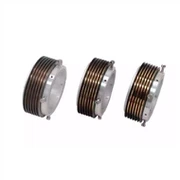
What is Waveguide Coaxial Converter?
Jul 05, 2023
Products Description

Waveguide coaxial converters play a pivotal role in microwave systems by providing seamless transitions between waveguides and coaxial transmission lines. This article aims to provide a comprehensive overview of waveguide coaxial converters, including their working principles, types, design considerations, applications, and future prospects.
Working Principles
Waveguide coaxial converters facilitate the efficient transfer of electromagnetic signals between two distinct transmission mediums: waveguides and coaxial lines. They serve as impedance-matching devices, enabling smooth signal propagation despite the impedance mismatch between these two transmission lines. The working principle of a waveguide coaxial converter involves converting the mode of signal propagation from the dominant mode in the waveguide to the transverse electromagnetic (TEM) mode in the coaxial line or vice versa.
Types of Waveguide Coaxial Converters
There are several types of waveguide coaxial converters designed to cater to different frequency ranges, power levels, and port configurations. Some common types include:
- Rectangular-to-Coaxial Converter:
This type of converter is used to transition from a rectangular waveguide to a coaxial transmission line. It typically consists of a rectangular waveguide section, followed by a flared section that gradually transitions the electromagnetic field from the waveguide mode to the coaxial mode.
- Coaxial-to-Rectangular Converter:
As the name suggests, this converter enables the transition from a coaxial transmission line to a rectangular waveguide. It employs a tapered structure that gradually transforms the TEM mode of the coaxial line to the dominant mode of the rectangular waveguide.
- Dual-Ridged Waveguide-to-Coaxial Converter:
This converter is commonly used for broadband applications and allows the conversion from a dual-ridged waveguide to a coaxial line. Dual-ridged waveguides support multiple modes, and this converter ensures efficient mode conversion to the TEM mode.
- Coaxial-to-Dual-Ridged Waveguide Converter:
This converter facilitates a smooth transition from a coaxial line to a dual-ridged waveguide. It converts the TEM mode of the coaxial line to the desired modes supported by the dual-ridged waveguide.
Design Considerations
Designing waveguide coaxial converters involves several critical considerations to ensure optimal performance and minimal signal losses:
4.1 Frequency Range:
The converter's design must cater to the specific frequency range of operation to maintain proper impedance matching and minimize reflections.
4.2 Impedance Matching:
Achieving impedance matching between the waveguide and coaxial lines is crucial to minimize signal reflections at the interface. This is typically achieved through careful dimensioning and optimizing the geometry of the converter.
4.3 Power Handling:
The converter should be designed to handle the anticipated power levels without excessive losses or degradation. This may involve selecting appropriate materials and implementing effective thermal management techniques.
4.4 Insertion Loss:
Minimizing insertion loss is vital to preserve signal integrity during the conversion process. Careful attention should be given to reducing any losses introduced by mismatches, material properties, or structural imperfections.
4.5 Return Loss:
A low return loss indicates efficient impedance matching and minimal reflection. Designing waveguide coaxial converters with low return loss helps ensure maximum power transfer and system performance.
Application
Waveguide coaxial converters find applications in various microwave systems, where seamless transitions between waveguides and coaxial transmission lines are essential:
5.1 Communication Systems:
Waveguide coaxial converters enable efficient interconnections between waveguide-based radio frequency (RF) systems and coaxial cables commonly used in communication networks. They facilitate the transmission and reception of signals in devices such as antennas, transceivers, and base stations.
5.2 Test and Measurement:
In RF testing setups, waveguide coaxial converters provide the necessary interfaces to connect waveguide devices with coaxial test equipment. This allows for accurate measurement, calibration, and verification of microwave components and systems.
5.3 Radar Systems:
Waveguide coaxial converters play a vital role in radar systems by connecting waveguide-based antenna arrays with coaxial feeds. They ensure proper impedance matching and efficient signal transfer, enabling precise radar beamforming and target detection.
5.4 Satellite Communication:
In satellite downlink/uplink systems, waveguide coaxial converters enable the seamless transition between the waveguide-driven signals from the satellite antenna and the coaxial cables used for signal distribution or reception.
5.5 Medical Applications:
Waveguide coaxial converters find application in medical devices such as magnetic resonance imaging (MRI) systems, where efficient transitions between waveguides and coaxial transmission lines are required for RF signal distribution and reception.
Conclusion
Waveguide coaxial converters are integral components in microwave systems, providing seamless transitions between waveguides and coaxial transmission lines. By enabling efficient mode conversion and impedance matching, they ensure optimal signal propagation and minimize losses. Waveguide coaxial converters find applications in communication systems, radar systems, test and measurement setups, satellite communication, and medical devices. Continued advancements in broadband operation, high-power handling, miniaturization, multimode capabilities, and hybrid integration will contribute to enhanced performance and expanded applications in the future of waveguide coaxial converters, enabling efficient and reliable microwave system designs.
Company Profile

Xi'an WinFine Telecom Technology Pte.,Ltd (WinFine Telecom hereinafter) is a leading microwave waveguide components, assemblies and antenna systems manufacturer in China. Established in 2011, WinFine Telecom is continually growing to meet customer's needs.
Our highly trained design engineers and manufacturing personnel can handle both standard and custom products to meet your needs. Our in house design, manufacturing, inspection and quality control capabilities allow fast response to customer requirements.
Our standard delivery time is only half of the average western supplier's standard delivery time.
Our microwave measurement capability up to 60GHz makes us the best choice for the design and manufacturing of your components.
We implement TQM (Total Quality System) and SOP (Standard Operation Procedure) with ISO 9001:2017 certification, which assures WinFine Telecom's strong commitment to quality standards and customer satisfaction. We are confident we offer well-engineered, high quality products at globally competitive prices. Our mission is to satisfy our customers by providing timely and cost effective solutions without compromising quality, performance and delivery.
Tel: +86-18792701548
WhatsApp: 86-18792701548
Email: janet@efinecom.com
Add: RM31810, Unit 3, Building 6, HuaCheng International, No.82, ChangAn South Road, Xi'an City, Shaanxi Province, P.R. China