

What is the frequency range of the biconical antenna?
Nov 16, 2022
For many years, most regulatory standards required the use of half-wave dipole antennas with frequencies higher than 20 MHz. However, in order to shorten the test time, the broadband antenna such as biconical antenna began to be accepted. Compared to half-wave dipoles, wideband antennas shorten test time because technicians do not have to stop testing to adjust the length of the dipole element for each frequency of interest.
Bipyramidal antennas are considered standard work in every compliance testing laboratory for a variety of applications such as radiated emission, immunity, and shielding effectiveness testing; This antenna has proven to be a valuable asset. Bipyramidal antennas are also used in normalized site attenuation (NSA) measurements, site evaluation (CISPR 16-1-4 SVSWR procedure), and spectrum monitoring applications.
Antenna characteristics
Bipyramidal antennas have several unique antenna characteristics that distinguish them from other antenna types. These wire-polarized antennas are typically used for compliance testing in the frequency range of 20MHz to 300MHz; We have several models that cover this frequency range, and there are others that cover 18GHz.
Size and shape
Bipyramidal antennas are similar to dipole antennas, except that they have tapered elements. They also have an integrated balun (balanced to unbalanced) structure with impedance matched to the elements of the transmission line. Some baluns are built for high power and are suitable for immunity testing. In most cases, these lightweight antennas have removable parts for easy storage. The elements of our folding bipyramidal antenna can also be closed like an umbrella so that the antenna can be packed in a compact transport case.
Bandwidth
Antenna bandwidth is the total frequency range over which the antenna can operate. These types of antennas have a wide frequency range from 20MHz to 18GHz. One of the advantages of a bipyramidal antenna is its small size and wide coverage.
Radiation pattern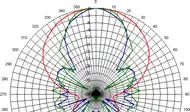
A radiation pattern is a graph of the change in the angular function of the antenna field strength relative to the axis. The radiation pattern of a bipyramidal antenna is similar to a half-wave dipole. They have an omnidirectional response in the H plane and a figure 8 on the E plane. H-plane beamwidth patterns make these antennas ideal for field surveys and spectrum monitoring.
Advantage
There are several benefits to choosing a bipyramid antenna for test applications. One of the biggest benefits is the small size. A similar dipole antenna operating in the same frequency range is 16 feet wide, while a bipyramid antenna is only 3 feet wide. Another benefit is wide frequency coverage. Whether performing standard compliance tests or simply using them for on-site monitoring, these antennas show efficient performance characteristics. Below is a comparison of the different versions of the bipyramid antenna we offer and some of their unique features.
 |  |  |
| SAS-540, 20MHz-330MHz, transmitted, non-foldable | SAS-542, 20MHz-330MHz, transmitted, portable and foldable | SAS-543, 20MHz-300MHz, anti-interference, non-foldable |
 |  |  |  |
| SAS-544, 20MHz-300MHz, shielding effectiveness, non-foldable | SAS-544F, 20MHz-300MHz, portable shielding efficiency, foldable | SAS-545, 30MHz-1GHz, spectrum monitoring | SAS-547, 1GHz-18GHz, SVSWR Field Evaluation, Fixed |
We specialize in producing microwave waveguide components, slip rings, waveguide tubes, antennas, and other telecommunication components for the global market. Strict quality control and ISO 9001 management system certification. If you are interested in it, we will send the catalog to you. Thanks! You can also leave a message at any time, we will reply as soon as we see it, contact us for more details: E-mail: janet@efinecom.com.


