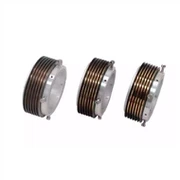
What is waveguide to coaxial adapters ?
Jul 27, 2023
Abstract:
This paper presents a comprehensive analysis of waveguide to coaxial adapters with a focus on the right angle configuration. These adapters serve as essential components in microwave and RF systems, allowing for seamless transition between waveguide and coaxial transmission lines. The study explores the principles of operation, design considerations, applications, and recent advancements in waveguide to coaxial adapters with a particular emphasis on the right angle configuration.
1. Introduction
Waveguide to coaxial adapters play a crucial role in bridging the gap between waveguide and coaxial transmission lines. This section introduces the concept of waveguide to coaxial adapters, highlighting their significance in enabling efficient signal transfer between different transmission mediums. The motivation behind using right angle configurations in these adapters is discussed, emphasizing their advantages in terms of space-saving, ease of installation, and impedance matching.
2. Principles of Operation
This section provides an overview of the underlying principles governing waveguide to coaxial adapters. It explores the fundamentals of waveguide and coaxial transmission lines, discussing the challenges associated with their impedance mismatch and the need for transition structures. The operation of right angle adapters, incorporating bends and transitions, are explained, emphasizing the importance of impedance matching and minimizing reflections.
3. Design Considerations
Efficient design of waveguide to coaxial adapters requires careful consideration of several factors. This section discusses key design considerations, including impedance matching, transmission loss, frequency ranges, and power handling capabilities. The impact of these parameters on the overall performance and reliability of the adapters is explored, along with techniques for optimizing their design.
4. Right Angle Adapter Configurations
The right angle configuration offers unique advantages in certain applications due to its compactness and adaptability. This section explores different right angle adapter configurations, such as E-plane and H-plane bends, mitered bends, and waveguide probe transitions. Each configuration is discussed in terms of its benefits, limitations, and suitability for specific frequency ranges and power levels.
5. Applications
Waveguide to coaxial adapters with right angle configurations find a wide range of applications in microwave and RF systems. This section highlights their usage in areas such as antenna feed networks, instrumentation, radar systems, and satellite communications. The paper discusses the specific requirements and challenges faced in each application, emphasizing the importance of accurate impedance matching and signal integrity preservation.
6. Recent Advances and Innovations
Ongoing research and technological advancements have led to notable improvements in waveguide to coaxial adapters with right angle configurations. This section explores recent innovations, such as the development of miniaturized adapters, improved bandwidth capabilities, and reduced losses. Additionally, advancements in fabrication techniques, incorporation of advanced materials, and the integration of signal conditioning circuits are discussed, showcasing their impact on adapter performance and system efficiency.
7. Performance Evaluation and Measurement
Accurate evaluation of the performance of waveguide to coaxial adapters is crucial for ensuring optimal functionality. This section discusses key performance parameters, including return loss, insertion loss, VSWR, and phase stability. Various measurement techniques, such as vector network analyzers and time-domain reflectometry, are explored to assess the characteristics and performance of these adapters accurately.
8. Challenges and Future Outlook
Waveguide to coaxial adapters with right angle configurations face challenges related to frequency limitations, higher power requirements, and increased demand for compactness. This section highlights these challenges and presents potential solutions based on ongoing research and advancements in material science, fabrication techniques, and computational modeling. The paper concludes with an outlook on future trends, including the development of even smaller form factors, wider bandwidth capabilities, and enhanced integration with emerging technologies like 5G and Internet of Things (IoT).
9. Conclusion
In conclusion, waveguide to coaxial adapters with right angle configurations play a critical role in enabling seamless transition between waveguide and coaxial transmission lines. This paper has provided a comprehensive overview of their principles, design considerations, applications, recent advances, and future prospects. By understanding the fundamental concepts and design considerations associated with these adapters, engineers and researchers can make informed decisions, contributing to the continuous improvement and innovation of this vital component.
Keywords: Waveguide to coaxial adapters, right angle configuration, microwave engineering, impedance matching, signal integrity preservation.