

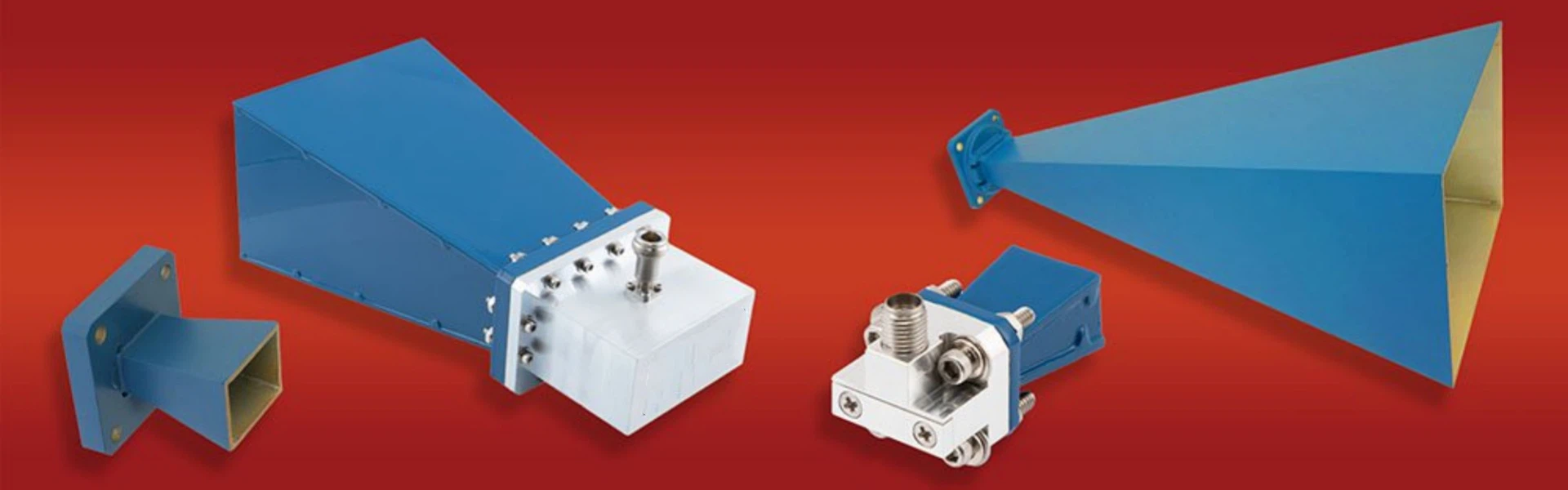


Standard Gain Horn Antenna
Model:EF-3SGAH10N
Frequency domain(GHz):0.32-0.49
Length(mm):850
Flange/interface:N-K
Materials:Aluminum
Gain:10
DimensionsL1:300
DimensionsW:1150
DimensionsH:800
Coating:oxidation
Description:
A horn antenna can be viewed as a gradually opening waveguide. The function of the horn is to generate a uniform phase wavefront over the larger aperture of the waveguide, resulting in higher directivity. A standard gain horn antenna is a horn antenna whose gain is scaled to the frequency characteristics. The bandwidth of the horn antenna is determined by the operating frequency range of the main mode in the waveguide connected to it. The operating frequency of the rectangular waveguide is determined by the operating frequency range of the main mode TE10 mode, and the gain is mainly from 10 dB to 25 dB.
| Model Number | Frequency Range (GHz) | Gain (dBi) | Average 3dB Beamwidth | Average VSWR | |
| E-Plane | H-Plane | ||||
| SAS-580 | 1.1 - 1.7 | 15 | 29° | 28° | 1.2 : 1 |
| SAS-581-10 | 1.7 - 2.6 | 10 | 65° | 45° | >1.6:1 |
| SAS-581 | 1.7 - 2.6 | 15 | 28° | 29° | 1.3 : 1 |
| SAS-582 | 2.6 - 3.95 | 15 | 28° | 29° | 1.25 : 1 |
| SAS-582-20 | 2.6 - 3.95 | 20 | 17° | 16.8° | 1.16 : 1 |
| SAS-583-10 | 3.95 - 5.85 | 10 | 55° | 54° | > 1.5:1 |
| SAS-583 | 3.95 - 5.85 | 15 | 29° | 29° | 1.35 : 1 |
| SAS-583-20 | 3.95 - 5.85 | 20 | 19.4° | 18.8° | 1.19 : 1 |
| SAS-584-10 | 5.85 - 8.2 | 10 | 55° | 54° | |
| SAS-584 | 5.85 - 8.2 | 15 | 30° | 29° | 1.2 : 1 |
| SAS-584-20 | 5.85 - 8.2 | 20 | 19° | 18.6° | 1.11 : 1 |
| SAS-585-10 | 8.2 - 12.4 | 10 | 48° | 47° | 1.3 : 1 |
| SAS-585 | 8.2 - 12.4 | 15 | 30° | 30° | 1.3 : 1 |
| SAS-585-20 | 8.2 - 12.4 | 20 | 15.9 ° | 16.3 ° | 1.15 : 1 |
| SAS-586-10 | 12.4 - 18 | 10 | 56° | 51° | > 1.5:1 |
| SAS-586 | 12.4 - 18 | 15 | 30° | 29° | 1.3 : 1 |
| SAS-586-20 | 12.4 - 18 | 20 | 18.5° | 19° | 1.2 : 1 |
| SAS-587-10 | 18 - 26.5 | 10 | 58° | 57° | > 1.5:1 |
| SAS-587 | 18 - 26.5 | 15 | 30° | 30° | 1.25 : 1 |
| SAS-572 | 18 - 26.5 | 20 | 18° | 17° | > 2:1 |
| SAS-588-10 | |||||
| SAS-572 | 18 - 26.5 | 20 | 18° | 17° | > 2:1 |
| 26.5 - 40 | 10 | ||||
| SAS-588 | 26.5 - 40 | 15 | 32° | 31° | 1.3 : 1 |
| SAS-573 | 26.5 - 40 | 20 | 18° | 16° | >1.5 : 1 |
Applications:
1.Automotive Antenna Test Solutions
Cars are becoming 'antenna farms' with as many as 10 to 80 antennas mounted on them with the addition of new consumer-oriented services. Military vehicles and industrial fleet vehicles also continually add additional antennas for specialized communications, movement coordination and data gathering. While conventional antenna testing techniques are not effective due to new spatial coverage and frequency requirements, NSI-MI has developed solutions for automotive antenna testing applications. Our systems allow for the characterization of antennas for cell phones, GPS, satellite radio, collision avoidance, automated tolling, traffic monitoring, personal area networking, AM/FM radio, and more. NSI-MI has developed spherical near-field measurement systems for vehicular antenna testing applications in both indoor and outdoor environments.
2.General Antenna Testing
Our test and measurement facilities coupled with our highly experienced staff are available to support your testing requirements. Whether you need to test in the near-field, far-field or a compact range, NSI-MI can provide accurate and fast results.
3.Radar Cross Section
We provide state-of-the-art radar cross section measurement systems suitable for measuring small-scale test articles and/or full-scale vehicles depending on customer requirements.
4.Radome Testing
The military and commercial aircraft carry a vast array of antennas for specialized and vital functions. Communications, navigation, weather and fire control antennas must perform as specified to meet safety and mission requirements. Radomes must conceal and protect antennas without interfering with or degrading transmit/receive capabilities.
5.Satellite Antenna Testing
RF testing of flight hardware poses challenges that are unique to the space industry and antennas specifically, are often delicate and gravitationally sensitive. Minimizing or even avoiding motion of these antennas during testing is highly desirable for two reasons: Firstly, it minimizes risk to the antennas. Secondly, the standard gain horn antenna can be deployed with respect to a fixed gravity vector.
6.Wireles
Wireless networks rely on antennas and our products allow for the reliable characterization of these antennas. We offer test systems that are suitable for evaluation of electrically small handset or other UE antennas, as well as electrically large base station antennas.

FAQ
1.Q: Are you a manufacturer or trading company?
A:Yes, we are manufacturer.Our company has 15 years of professional experience in the telecom field, which can design, manufacture a wide range of microwave waveguide components, coaxial components, antennas and other telecommunication components to global market.
2.Q: How do I get samples?
A: We need to receive your payment before we can send the samples to you. After the customer confirms the order, we will reduce the sample cost. However, if you are our regular customer, we can send the sample to you and then deduct it from your account in the next transaction.
3.Q: What are your payment terms?
A: Small batch orders or urgent orders, you can choose PayPal, Western Union, Escrow to facilitate buyers, 100% payment before shipment; for large orders: 30%/50% of T/T as deposit, the balance before shipment.
4.Q: How long is your delivery time?
A:Usually 7-15 working days after receiving your 100% payment. For bulk orders: 15-35 working days after receiving the deposit.
5.Q: How do you solve after-sales service issues?
A: After receiving the goods, if you have any dissatisfaction or other issues, please contact us ASAP, we will give you a fast response and reasonable solution.
Hot Tags: standard gain horn antenna, China standard gain horn antenna manufacturers, suppliers, factory, wr770 horn, parabolic horn, horn antenna in satellite communication, wr430 horn antenna, quad ridge horn, exponential horn antenna


Send Inquiry
