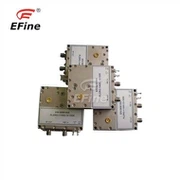
Winfine Digital Attenuator for military applications?
Aug 03, 2023
Abstract:
This paper provides a comprehensive overview of digital attenuators, including their design principles, applications, and recent advancements. Digital attenuators are versatile electronic devices used to control the amplitude of signals in various industries, such as telecommunications, RF testing, and wireless communications. The paper discusses the fundamental design considerations, important features of digital attenuators, and their diverse range of applications. Additionally, it explores recent developments in this field, including miniaturization, increased bandwidth, and advanced control interfaces.
Keywords: digital attenuator, design, applications, advancements, signal control

1. Introduction
Digital attenuators play a crucial role in controlling signal amplitudes in modern electronic systems. They provide precise control over signal levels, enabling optimization of system performance. This paper aims to provide a comprehensive overview of the design principles, applications, and recent advancements in digital attenuators.
2. Design Principles
2.1 Attenuation Range: Digital attenuators are designed to provide a wide range of attenuation levels, typically measured in decibels (dB). The attenuation range determines the maximum and minimum signal levels that can be achieved.
2.2 Resolution: The resolution of a digital attenuator refers to the smallest increment in attenuation level that can be achieved. Higher resolution allows for fine-grained control over signal amplitudes.
2.3 Fast Switching Speed: The switching speed of a digital attenuator refers to the time it takes to change from one attenuation level to another. Fast switching speed is essential for applications that require rapid adjustment of signal amplitudes.
2.4 Dynamic Range: The dynamic range of a digital attenuator indicates the ratio between the highest and lowest signal levels it can handle without distortion. A wide dynamic range ensures accurate and reliable signal control.
3. Important Features
3.1 Voltage Control: Digital attenuators can be controlled through voltage signals, making them compatible with a wide range of electronic systems and control interfaces.
3.2 Nonlinearity and Distortion: Digital attenuators strive to minimize nonlinearity and distortion to maintain the integrity of the signal passing through them. This ensures accurate and consistent signal control.
3.3 Frequency Bandwidth: The frequency bandwidth of a digital attenuator determines the range of frequencies it can effectively attenuate. Higher bandwidth enables versatile applications in different frequency bands.
3.4 Power Handling: Digital attenuators are designed to handle specific power levels, which depend on the application requirements and the desired signal integrity.
4. Applications
4.1 Telecommunications: Digital attenuators are widely used in telecommunications systems for signal conditioning, gain control, and power control. They enable precise adjustment of signal amplitudes in optical networks, radio systems, and base stations.
4.2 RF Testing and Measurement: Digital attenuators play a vital role in RF testing and measurement setups, ensuring accurate signal power calibration and receiver sensitivity testing. They are used in network analyzers, spectrum analyzers, and wireless communication test equipment.
4.3 Wireless Communications: In wireless communication systems, digital attenuators are employed for signal leveling, fading simulation, and power control in transceivers and satellite communication systems.
4.4 Research and Development: Digital attenuators find extensive use in research laboratories for experimental setups, signal modulation, and characterization of devices. They provide flexibility and precision in controlling signal amplitudes for various research applications.
5. Recent Advancements
5.1 Miniaturization: Ongoing advancements focus on miniaturizing digital attenuators, enabling their integration into compact electronic systems, such as portable devices, IoT devices, and wearable technology. This allows for greater flexibility in signal control applications.
5.2 Increased Bandwidth: Research efforts aim to increase the bandwidth of digital attenuators to address the growing demand for high-frequency applications. This includes millimeter-wave and terahertz frequency ranges, where wide bandwidth and accurate signal control are essential.
5.3 Advanced Control Interfaces: Recent developments include the incorporation of advanced control interfaces, such as USB, Ethernet, or wireless connectivity options. These interfaces provide seamless integration with modern control systems and enable remote control and automation.
5.4 Digital Signal Processing Integration: Digital attenuators can be integrated with digital signal processing techniques to achieve dynamic channel equalization and adaptive signal control. This integration enables more sophisticated and efficient signal attenuation methods.
6. Conclusion
Digital attenuators are versatile electronic devices used for precise control of signal amplitudes in various applications. This paper discussed the design principles, important features, and applications of digital attenuators. Recent advancements in miniaturization, increased bandwidth, advanced control interfaces, and integration with digital signal processing techniques have expanded their capabilities. Future prospects include further miniaturization, wider bandwidth, and enhanced integration with advanced control systems. Continued research and development in these areas will drive further advancements, leading to improved performance and innovative applications for digital attenuators in diverse industries.