What are the microwave antenna types?
Dec 05, 2022
Transmitting or receiving antennas that work in meter-wave, centimeter-wave, millimeter-wave and other wavelength bands are collectively referred to as microstrip microwave antennas. Microwaves mainly rely on space wave propagation, and antennas are erected higher to increase the communication distance. In microwave antennas, the widely used parabolic antennas, horn parabolic antennas, horn antennas, lens antennas, slotted antennas, dielectric antennas, periscope antennas, etc. are widely used.
Requirements for antennas working in microwave bands: (1) high mechanical strength and operational reliability; (2) The size and weight of the antenna should be small; (3) The antenna and the feeder should be matched and easy to tune; (4) The manufacture and assembly of the antenna should be simple and the cost should be low.
Microwave antenna classification
Microwave antennas are divided into two types of microwave antennas: hanging antennas and seat antennas according to the installation method.
According to electrical characteristics: standard antenna and high-performance antenna two kinds of microwave antenna.
The difference between standard antennas and high-performance antennas is that the front-to-back ratio of high-performance antennas is larger than that of standard antennas, generally more than 10dB larger.
▲Directional antenna: Small coverage but long distance, suitable for remote point-to-point connections.
The classification of directional antennas is further divided into flat panel antennas, grid antennas, and sector antennas.
▲Omnidirectional antenna: large coverage but close distance, suitable for wireless coverage.
Omnidirectional antennas are classified into rod antennas, ceiling antennas, and vehicle antennas.
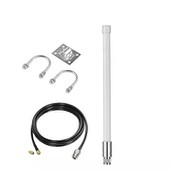
▲Rod antenna: Rod antenna is suitable for each bridge point is close, the distribution angle range is large and the number is large, and the three general use distance range is within 3 kilometers.
 |  |  |
| Directional antenna | Omnidirectional antenna | Rod antenna |
▲Sector antenna: this type of antenna has energy orientation and convergence function, can effectively carry out horizontal coverage within 180 degrees, 120 degrees, 90 degrees, when the bridge point is concentrated in a certain angle, you can choose this type of antenna, generally within 6 kilometers.
▲Ceiling antenna: indoor ceiling antenna is generally installed on the ceiling for indoor coverage, light structure, beautiful appearance, easy installation.
▲Flat panel antenna: The wave speed angle of the flat panel antenna can be divided into 30 degrees and 15 degrees, a few angles are 9 degrees, and the energy gathering ability is strong, suitable for remote connection points are relatively concentrated and the number of small environments, the connection distance is within 20 kilometers.
 |  |  |
| Sector antenna | Ceiling antenna | Flat panel antenna |
▲Parabolic antenna: Parabolic antenna is a type of antenna with the strongest energy convergence ability and the best directivity of the signal direction in directional antenna, when the bridge point position is fixed and the number of cuts is small and concentrated in the project, this type of antenna is the best choice, generally used as point-to-point communication, the connection distance is more than 20 kilometers.

The role and status of the antenna
The RF signal power output by the radio transmitter is transmitted to the antenna through the feeder (cable), which radiates out in the form of electromagnetic waves. After the electromagnetic wave arrives at the receiving location, the antenna follows (only a small and small part of the power) and is sent to the radio receiver through the feeder. It can be seen that the antenna is an important radio device for transmitting and receiving electromagnetic waves, and there is no radio communication without the antenna.
We specialize in producing microwave waveguide components, slip rings, waveguide tubes, antennas, and other telecommunication components for the global market. Strict quality control and ISO 9001 management system certification. If you are interested in it, we will send the catalog to you. Thanks! You can also leave a message at any time, we will reply as soon as we see it, contact us for more details: E-mail: janet@efinecom.com.